
A driver turned left across your lane on Franklin Boulevard, or changed lanes into you on I-85, and now the insurer says you were speeding. In North Carolina that story can erase your claim. Free consultation, no fee unless we win.
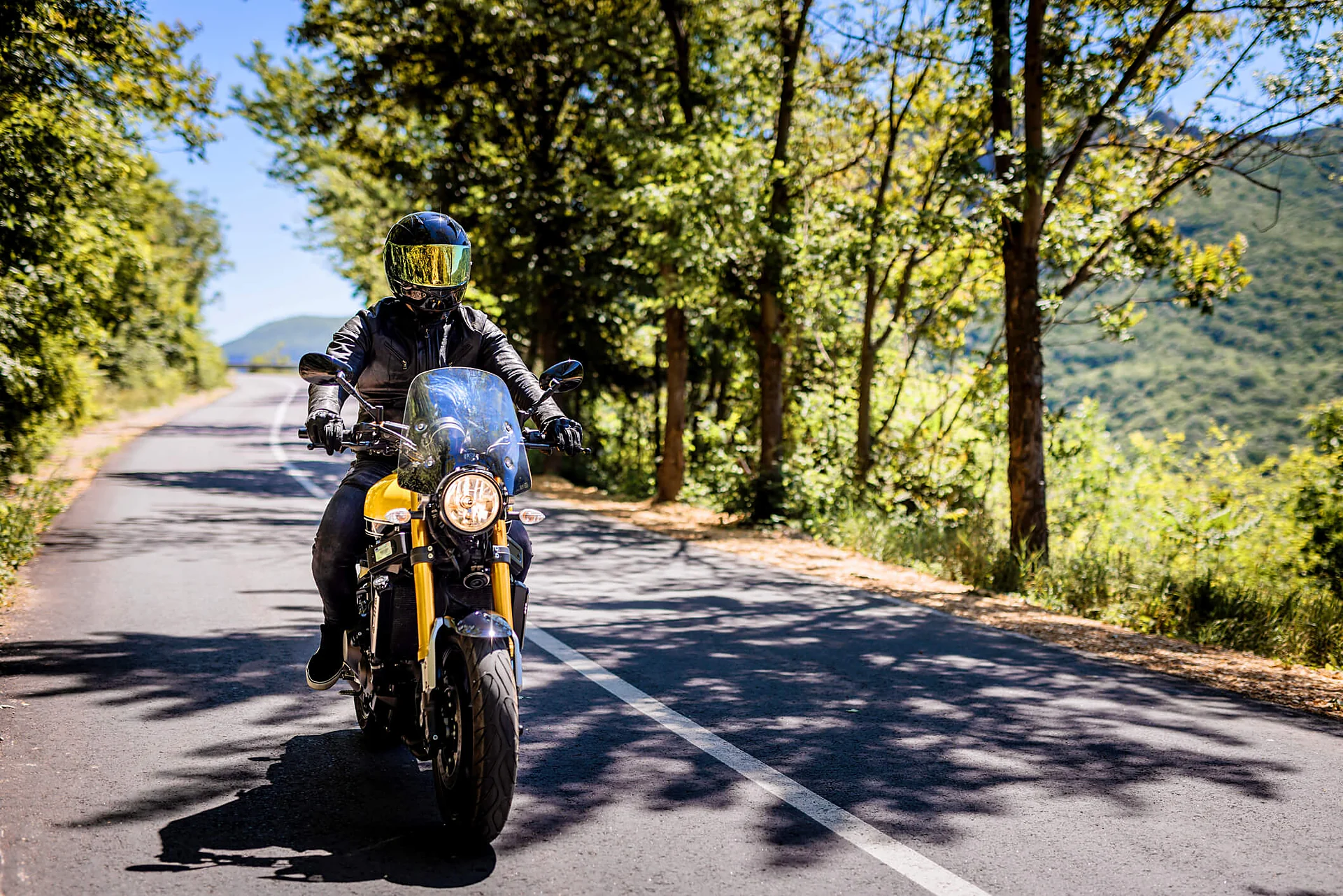
Gaston County is a riding county. The two-lane roads toward Crowders Mountain and the South Mountains, the US-321 run toward Lincolnton, and the weekend routes into the foothills draw riders from across the Charlotte metro, and they all pass through Gastonia’s traffic to get there: I-85, Franklin Boulevard, New Hope Road, Union Road. That is where the crashes happen, and they almost always start the same way. A driver turns left across the rider’s lane or drifts into it, says “I didn’t see him,” and the rider, with no steel around them, takes the impact. Then the driver’s insurer builds a story in which the rider was speeding, weaving, or came out of nowhere.
In most states that story trims the claim. In North Carolina, one of only four states still following pure contributory negligence, it can end the claim outright. Joshua E. Palmer, Attorney at Law represents injured riders in Gastonia and across the state; Attorney Palmer trained in North Carolina law at North Carolina Central University School of Law in Durham. Our North Carolina motorcycle accident lawyer page covers the statewide law; this page covers Gastonia, from the report agency and the trauma center to the local roads where riders get hurt.
| County | Gaston County |
|---|---|
| Where a lawsuit is filed | Gaston County Courthouse, 325 Dr. Martin Luther King Jr. Way, Gastonia. Injury lawsuits over $25,000 are filed in Gaston County Superior Court; smaller claims go to District Court. |
| Crash report (DMV-349) | Gastonia Police Department for crashes inside the city; the NC State Highway Patrol for I-85, US-321, and the rural roads outside city limits where many motorcycle crashes occur; the Gaston County Police on county roads. Certified DMV-349 copies come from NCDMV. |
| Emergency and trauma care | CaroMont Regional Medical Center in Gastonia, a Level III trauma center; riders with severe head, spinal, or orthopedic trauma may be transferred to a Charlotte trauma center. |
| Roads where crashes concentrate | I-85, US-321, US-29/74 (Franklin Boulevard), New Hope Road, Union Road, Cox Road, and the two-lane county roads toward Crowders Mountain and the foothills. |
| Riding gear as evidence | Keep your helmet, jacket, gloves, and boots in their post-crash condition and do not repair the motorcycle until it has been photographed and inspected. Damaged gear is proof of the force of the impact. |
Details current as of October 2026; confirm the courthouse and records office before you file or request anything in person.
Two places, with two different fault fights. In town, the crashes are left-turn and lane-change collisions: a driver turning left from Franklin Boulevard into a shopping center across the rider’s lane, a car pulling out of a New Hope Road driveway, a lane change on I-85 into the space a motorcycle occupied. The driver almost always says the rider was not visible or was going too fast, and the insurer repeats it.
Outside town, on US-321 and the county two-lanes toward the mountains, the crashes are single-vehicle or head-on: gravel in a curve, a pickup crossing the center line, a deer at dusk, a road defect. The defense in those cases is that the rider lost control on their own, which is why the crash scene, the road surface, and the other vehicle’s position have to be documented before they change. Both fights come down to evidence gathered in the first days.
Call 911 and stay at the scene if you physically can. The responding officer, Gastonia Police in town or the State Highway Patrol on I-85 and the county roads, files the DMV-349 crash report required by N.C. Gen. Stat. § 20-166.1, and that report records the vehicles, the point of impact, and the officer’s first read on fault. Get medical care the same day. CaroMont Regional Medical Center is the local trauma center; motorcycle injuries hide behind adrenaline, and a rider who walks away can learn about a fractured vertebra or a brain bleed two days later. Any gap before your first visit becomes the insurer’s argument that you were not hurt.
Photograph both vehicles, the driver’s position and sight line, skid marks, gravel or debris, and your gear. Keep the helmet, jacket, and boots exactly as they are. Get the driver’s license, plate, and insurance information and every witness’s number. Then talk to a lawyer before the other driver’s insurer calls; the recorded statement they want is a search for the admission that lets them deny the claim.
North Carolina has a universal helmet law: every operator and passenger must wear a helmet that meets the federal FMVSS 218 standard under N.C. Gen. Stat. § 20-140.4. But the same statute says a helmet violation is not negligence per se or contributory negligence per se in a civil action. In plain terms, not wearing a helmet cannot by itself be used to bar or reduce your injury claim. The question remains who caused the crash.
That does not make the helmet irrelevant. A compliant helmet removes an argument the insurer would otherwise make about head injuries, and a damaged helmet is evidence of the force of the impact, so keep it. Two related points riders ask about: lane splitting is not authorized in North Carolina, so it is an argument the insurer will make if it applies; and a rider’s speed is the most common contributory negligence claim, which is why event-data downloads, witness statements, and reconstruction matter in a Gaston County case.
North Carolina, along with just three other states and Washington, D.C., still follows pure contributory negligence. A rider who is proven to share any part of the fault, no matter how small, recovers nothing. Insurers call it the 1% rule as informal shorthand; the statute makes it a defense the other side must plead and prove under N.C. Gen. Stat. § 1-139. For riders the rule is especially dangerous because the anti-rider assumption, that motorcyclists are reckless, does the insurer’s work for it unless the evidence is nailed down.
The exceptions save many rider claims. Last clear chance applies when the driver had the final opportunity to avoid the crash and failed to take it, which is exactly the left-turn case where the driver could have waited. Gross negligence or willful and wanton conduct, such as a drunk driver on Franklin Boulevard at closing time, defeats the defense entirely. Our contributory negligence guide explains the rule and every exception in depth.
| Rule | North Carolina law | What it means for a Gastonia rider |
|---|---|---|
| Helmet law | Universal, N.C. Gen. Stat. § 20-140.4 | Required; a violation is not contributory negligence per se |
| Fault rule | Pure contributory negligence, N.C. Gen. Stat. § 1-139 | Any proven fault on your part can bar recovery; the defense must prove it |
| Injury lawsuit deadline | 3 years, N.C. Gen. Stat. § 1-52(16) | File in Gaston County Superior Court within 3 years of the crash |
| Wrongful death deadline | 2 years, N.C. Gen. Stat. § 1-53(4) | Runs from the date of death |
| Minimum liability insurance | $50k / $100k / $50k, N.C. Gen. Stat. § 20-279.21 | Rider injuries routinely exceed a minimum policy; UM/UIM matters |
Deadlines differ for claims against government entities and for minors. Talk to a lawyer about your specific dates.
The at-fault driver’s liability insurer pays first. The driver’s policy, if it was issued or renewed on or after July 1, 2025, must carry bodily injury limits of at least $50,000 per person and $100,000 per accident under N.C. Gen. Stat. § 20-279.21, and uninsured and underinsured motorist coverage no lower than that; an older policy keeps 30/60/25 until it renews. Rider injuries, road rash needing grafts, fractures, spinal and head trauma, exhaust a minimum policy almost immediately.
That makes your own coverage central. The UM/UIM coverage on your motorcycle policy, and sometimes on a car policy in your household, pays what the driver’s policy cannot. A hit-and-run is treated as an uninsured-driver claim once reported promptly. When the driver was working, the employer’s policy applies. Finding and stacking every policy that applies is a large part of what a lawyer does in a serious rider case.
Motorcycle cases are worth more than car cases with the same facts for one grim reason: the injuries are worse. A North Carolina claim recovers all of it, emergency care, surgery, rehabilitation, future treatment, lost wages and earning capacity, and non-economic damages for pain, suffering, disfigurement, and the loss of the life you had before. There is no cap on compensatory damages in an ordinary injury case; punitive damages for conduct like drunk driving are capped at the greater of three times compensatory damages or $250,000 under N.C. Gen. Stat. § 1D-25.
The number moves on two things: whether fault is locked onto the driver, and how much coverage exists. A rider claim the insurer believes it can beat on contributory negligence is offered a fraction of its value. Our settlement guide explains how North Carolina claims are valued and why an early offer, made before the surgeries are done, is almost always too low.
Because a rider’s claim in a contributory negligence state is won on evidence gathered in the first days, and that is how the firm handles every Gastonia case. We obtain the crash report, secure camera footage and vehicle data, preserve the motorcycle and your gear, interview witnesses before they scatter, and when the driver’s story needs answering, bring in an accident reconstructionist. We handle every call from the insurer, manage the medical bills and liens, and prepare the case as if it will be tried in Gaston County so the insurer prices it that way.
Gastonia riders are served by phone, video, and in person by appointment, including hospital and home visits during recovery. Consultations are free, and riders pay no fee unless we win. Our Gastonia personal injury page covers the other kinds of cases we handle in Gaston County.

Joshua E. Palmer
Managing Partner · Joshua E. Palmer, Attorney at Law
Attorney Palmer concentrates in personal injury law — car, truck, and motorcycle crashes, wrongful death, workplace injuries, and premises injuries — and personally handles the insurance fight that decides a North Carolina claim. He trained in North Carolina law at North Carolina Central University School of Law in Durham and represents clients throughout Gaston County.
Hurt on a motorcycle in Gastonia or anywhere in Gaston County? Call for a free, no-obligation case review. We will explain how North Carolina law applies to your crash, what your claim may be worth, and what to do next.
Responsible attorney: Joshua E. Palmer, Managing Partner · 106 Moran Dr #5106, Bonaire, GA 31005 · (478) 887-3734. Attorney advertising. This page is general legal information about North Carolina law, not legal advice for your situation; contacting the firm does not create an attorney-client relationship.
One conversation can protect your claim from rider bias and North Carolina’s contributory negligence rule. Your consultation is free, and you pay nothing unless we win.
Each case is different. Any results, settlement figures, or benefit amounts described on this page depend on the specific facts of that case and do not guarantee or predict a similar outcome in yours. Statutes and benefit rates cited are current as of October 2026; confirm current law with an attorney before relying on it.
📞 Get A Free Consultation · (478) 887-3734