
Hit by a tractor-trailer on I-75 through Houston County, a delivery truck on Watson Boulevard, or a hauler on GA-247? The carrier’s insurer has investigators on the way, and under Georgia’s fault rule every percentage point they pin on you comes out of your recovery. Free consultation, no fee unless we win.
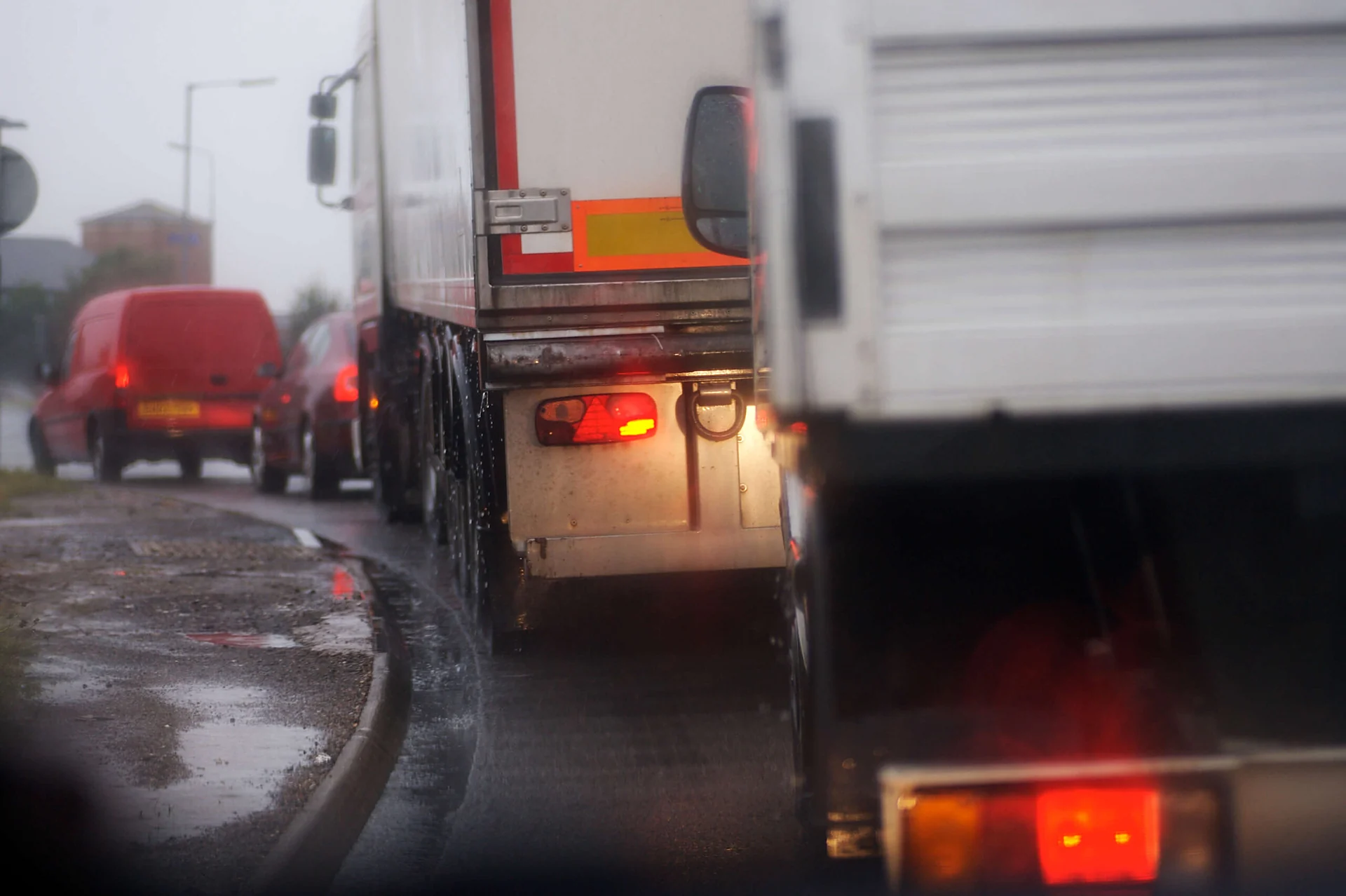
Freight moves around Warner Robins on three kinds of road. I-75 runs north-south through Houston County about six miles west of the city, carrying the Atlanta-to-Florida truck traffic that never stops. GA-247 and the GA-247 Connector feed the largest industrial complex in Georgia, Robins Air Force Base, where logistics is the business and the trucks that serve it share the road with a workforce of more than 25,000 at shift change. And Watson Boulevard, Russell Parkway, and Houston Lake Road carry the box trucks and delivery vans that supply a city of about 86,000 people. A fully loaded tractor-trailer weighs many times what a passenger car weighs, so when one of these trucks hits a car in Warner Robins the injuries are severe and the claim is immediately contested.
Joshua E. Palmer, Attorney at Law handles those cases from an office in Bonaire, in Houston County, minutes from Warner Robins. A truck crash is not a bigger car crash, and this page explains what is different about a Warner Robins case. Our Georgia truck accident lawyer page covers the statewide law in depth, and our Warner Robins personal injury lawyer page covers everything else the firm handles here.
| County | Houston County |
|---|---|
| Where a lawsuit is filed | Houston County Superior Court or the State Court of Houston County at the Houston County Courthouse, 201 N. Perry Parkway, Perry, GA 31069 (Perry is the county seat). Claims against an out-of-state carrier may also be removed to federal court; the State Court lists an annex at 200 Carl Vinson Parkway, Warner Robins. |
| Crash report | Georgia State Patrol for most I-75 truck crashes (report through the Department of Public Safety); Warner Robins Police Department inside the city (Georgia Open Records Act request to the WRPD Custodian of Records); Houston County Sheriff’s Office in unincorporated Houston County, Records (478) 542-2130. Copies also through the state’s BuyCrash service. |
| Emergency and trauma care | Houston Medical Center, 1601 Watson Boulevard, is the nearest emergency room; it holds no state trauma designation, so the catastrophic injuries a truck crash causes are usually flown or driven to Atrium Health Navicent in Macon, the nearest Level I trauma center. |
| Roads where crashes concentrate | I-75 through Houston County (about six miles west of Warner Robins), GA-247 (US 129) and the GA-247 Connector by Robins Air Force Base, GA-96 across the south side, Watson Boulevard, Russell Parkway, and Houston Lake Road. |
| Robins Air Force Base freight | The base is the largest industrial complex in Georgia, and the trucks that serve it use GA-247 and the Connector. A crash with a contractor’s truck is an ordinary Georgia claim against the contractor; a crash with a government-owned vehicle follows federal claim procedures with their own deadlines. |
Details current as of October 2026; confirm the courthouse and records office before you file or request anything in person.
Three reasons. First, the physics: a loaded tractor-trailer on I-75 or GA-247 needs far more room to stop than the cars around it, and the people in the car absorb nearly all of the force, which is why Warner Robins truck crashes so often end at the Level I trauma center in Macon rather than at Houston Medical Center. Second, the defendants: behind the driver stand the motor carrier, sometimes a separate truck owner, a trailer owner, a shipper or broker that set an impossible schedule, and a maintenance contractor, each with its own insurer. Third, the rules: interstate trucking is governed by federal safety regulations that create duties a car driver never has, and a violation of those rules is powerful evidence of negligence.
The carrier knows all of this and responds within hours: its insurer sends an investigator, and often a lawyer, to the scene on I-75 while you are still in the emergency room. A Warner Robins truck case is won by getting to the evidence just as fast.
The three we use most often are hours of service, maintenance, and testing. Under 49 C.F.R. § 395.3 a property-carrying driver may drive no more than 11 hours after 10 consecutive hours off duty and may not drive beyond the 14th hour after coming on duty, with a weekly limit on top; a driver who was over those hours on the Florida run through Houston County was fatigued by regulation, not by opinion, and the electronic logging device on the truck proves it. Under 49 C.F.R. § 396.3 the carrier must systematically inspect, repair, and maintain every vehicle it controls and keep the records; a brake or tire failure on GA-247 is usually a maintenance story the records tell. Under 49 C.F.R. § 382.301 the carrier must test a driver for controlled substances before putting him behind the wheel, and a carrier that skipped that step owns the consequences.
Georgia’s own rules apply alongside them. The duty to report a crash with injury or significant damage under O.C.G.A. § 40-6-273 brings the State Patrol or Warner Robins PD to the scene and produces the report. And Georgia’s minimum liability limits under O.C.G.A. § 33-7-11, $25,000 per person and $50,000 per crash, are irrelevant to a commercial carrier, which must carry far higher federal minimums; the real fight in a Warner Robins truck case is not whether enough coverage exists but which companies’ policies apply and how much of the fault each one wears.
The truck itself is the most important witness, and it is also the carrier’s property. The engine control module records speed, throttle, and braking in the seconds before impact; the electronic logging device records the driver’s hours; many cabs carry forward-facing and driver-facing cameras; and the carrier’s files hold the driver’s qualification file, training, prior violations, drug-test results, dispatch messages, and the bill of lading that shows what the truck was carrying and on whose schedule. None of that is preserved for you automatically, and some of it is overwritten in the ordinary course of business within days.
The first thing we do in a Warner Robins truck case is send a written preservation demand to the carrier, its insurer, and any other company behind the truck, putting them on notice that the vehicle, the data, and the records must be kept. We also pull the crash report, locate the dashcams and business cameras along the route, and inspect the truck before it goes back into service. Evidence gathered in the first two weeks is what lets us put the fault where it belongs when the carrier’s insurer starts arguing it belongs with you.
Under O.C.G.A. § 51-12-33, Georgia’s modified comparative negligence statute, the jury divides 100% of the fault among everyone who contributed to the crash, parties and non-parties alike, and reduces your recovery by the share assigned to you. If your share is 50% or more, you recover nothing. In a two-car wreck that is a single argument about you and the other driver. In a Warner Robins truck crash it becomes a multi-sided fight: the driver blames the carrier’s schedule, the carrier blames the broker, both blame the maintenance shop, and all of them blame you for the lane change on I-75 or the slow merge from the GA-247 Connector.
Apportionment cuts both ways, and a lawyer uses it. Spreading fault across the driver, the carrier, and the maintenance contractor means several insurers are paying, and it keeps the defense from pointing to an empty chair, a non-party it blames to shrink its own share. Keeping your own percentage near zero is the other half of the job, and it depends on the same evidence: the truck’s data showing how fast it was going, the logs showing how long the driver had been on the road, and the camera showing which vehicle moved first.
Potentially every company that touched the truck or the load. The driver, for the driving itself. The motor carrier, both for its own negligence in hiring, training, scheduling, and maintenance and for the driver’s conduct on the job. The owner of the tractor or trailer, when they are leased from someone else. The shipper or broker, when it set a delivery window that could only be met by violating the hours-of-service rule. The maintenance contractor, when a brake or tire failure caused the crash. And in a crash on GA-247 near Robins Air Force Base, a government contractor hauling for the base is an ordinary private defendant, while a government-owned vehicle brings federal claim procedures with their own notice rules and deadlines.
We trace the truck’s registration, the carrier’s federal operating authority, the lease agreements, and the bill of lading to put every responsible company in the Warner Robins case before the deadline runs.
Two years from the date of the crash under O.C.G.A. § 9-3-33 for an injury claim, and two years from the date of death if someone in the car was killed. The case is filed in Houston County Superior Court or the State Court of Houston County at the courthouse at 201 N. Perry Parkway in Perry, the county seat, or in the county where the carrier is based; because most carriers are headquartered out of state, the company will often move a Warner Robins case to federal court, which changes the procedure but not the Georgia law that governs fault and damages.
Because the crash happened here and the evidence is here. The firm’s only office is in Bonaire, minutes from Warner Robins, so we can be at a truck inspection on a Houston County lot or at a client’s hospital bed in Macon the same day. Attorney Palmer concentrates in car, truck, and motorcycle crash claims and personally handles the carrier’s insurer: the preservation demand goes out immediately, the truck’s data is downloaded before it is lost, the federal violations are documented, and the Warner Robins case is prepared for a Houston County jury so every insurer involved prices it as a trial case.
The consultation is free, in person at our Bonaire office, by phone, or by video, and the firm is paid only from the recovery. Earlier clients’ outcomes are on our case results page.

Joshua E. Palmer
Managing Partner · Joshua E. Palmer, Attorney at Law
Attorney Palmer concentrates in personal injury law — car, truck, and motorcycle crashes, wrongful death, workplace injuries, and premises injuries — and personally handles the insurance fight that decides a Georgia claim. The firm’s office is in Bonaire, in Houston County, next to Warner Robins, and it represents injury victims throughout Houston County.
Hit by a tractor-trailer on I-75, GA-247, or anywhere around Warner Robins? Call now so the preservation demand goes out before the carrier’s evidence disappears. The case review is free, and our Bonaire office is minutes away.
Responsible attorney: Joshua E. Palmer, Managing Partner · 106 Moran Dr #5106, Bonaire, GA 31005 · (478) 887-3734. Attorney advertising. This page is general legal information about Georgia law, not legal advice for your situation; contacting the firm does not create an attorney-client relationship.
Its investigators are working the crash today. A free call to a truck accident lawyer minutes away in Bonaire puts a preservation demand in their hands before the evidence is gone. No fee unless we win.
Each case is different. Any results, settlement figures, or benefit amounts described on this page depend on the specific facts of that case and do not guarantee or predict a similar outcome in yours. Statutes and benefit rates cited are current as of October 2026; confirm current law with an attorney before relying on it.
📞 Get A Free Consultation · (478) 887-3734