
Hit by an 18-wheeler or commercial truck anywhere in North Carolina? The trucking company’s response team is already working your crash. In a state where 1% of the fault can erase your claim, you need someone working it for you. Free consultation, no fee unless we win.
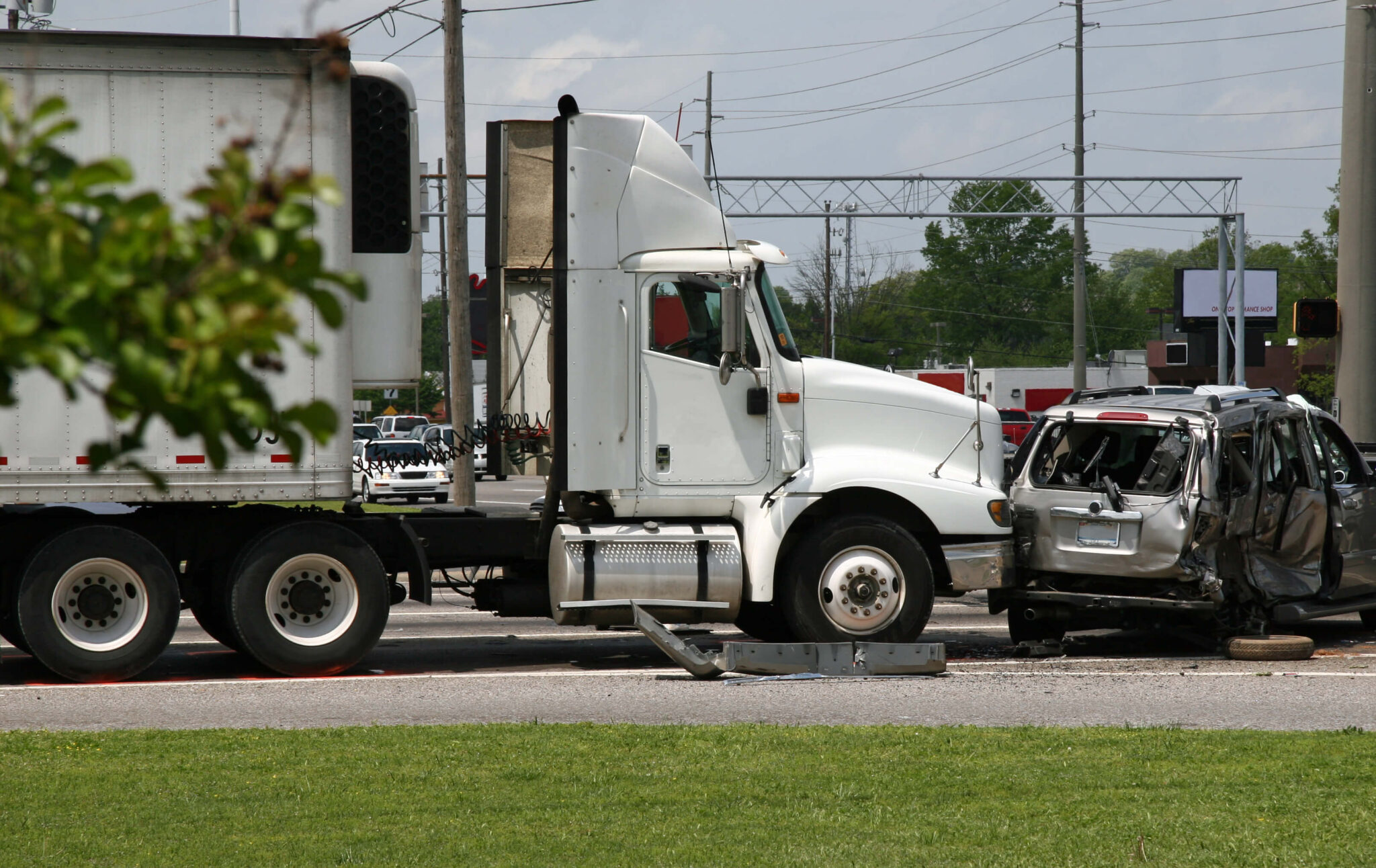
A crash with a tractor-trailer is not a car accident with a bigger vehicle. A loaded 18-wheeler can weigh 80,000 pounds, so the injuries are more often catastrophic, the insurance policies are far larger, and the defendant is a company with lawyers, investigators, and a plan for the day one of its trucks hurts someone. Within hours of a serious crash, many carriers dispatch a rapid-response team to photograph, interview, and shape the record before the injured person has left the emergency room.
North Carolina’s freight corridors — I-40, I-85, I-95, I-77, I-26, and US-74 — carry a steady stream of long-haul and regional truck traffic through Charlotte, the Triad, the Triangle, Fayetteville, and the port routes to Wilmington. Joshua E. Palmer, Attorney at Law concentrates in truck and commercial-vehicle injury claims and represents crash victims across North Carolina. Attorney Palmer earned his law degree at North Carolina Central University School of Law in Durham. This page explains how a North Carolina truck accident claim works, why it is different from an ordinary car crash, and what to do right now to protect it.
Call 911 and stay at the scene. The responding officer files a DMV-349 crash report with the Division of Motor Vehicles, and for a commercial truck the report will also identify the motor carrier, its USDOT number, and whether a post-crash inspection was done. Get medical care the same day — truck crashes cause internal and spinal injuries that do not always announce themselves at the scene, and a gap in treatment is the first thing the carrier’s adjuster will point to.
Then do what the trucking company is already doing: preserve evidence. Photograph the truck, its trailer, placards, and license plates; the road, skid marks, and debris field; and your own injuries. Get the names of every witness. Do not speak with the carrier’s insurer, its investigator, or anyone who arrives on the carrier’s behalf, and do not sign anything. In a contributory negligence state, a single sentence — “I didn’t see him,” “I may have drifted a little” — can become the company’s entire defense.
Because the defendant is usually a regulated business, and the rules it must follow become the standard your claim is measured against. Interstate motor carriers are governed by the Federal Motor Carrier Safety Regulations: hours-of-service limits on how long a driver can be behind the wheel, driver-qualification files, medical certification, drug and alcohol testing (including mandatory post-crash testing after serious wrecks), and scheduled inspection and maintenance of brakes, tires, lights, and coupling systems. A violation of any of these is powerful evidence of negligence.
The money is different, too. A private driver in North Carolina may carry a minimum policy. An interstate carrier hauling general freight must carry at least $750,000 in liability coverage under 49 C.F.R. § 387.9, and carriers hauling hazardous materials must carry far more; many carry $1 million or higher. That is why a truck case can fully compensate a catastrophic injury where a car case against a minimum policy cannot — and why the carrier’s insurer fights so hard.
| Issue | Typical car accident | Commercial truck accident |
|---|---|---|
| Who is liable | The at-fault driver | Driver, motor carrier, and often the shipper, loader, maintenance contractor, or manufacturer |
| Safety rules that apply | North Carolina traffic law | NC traffic law plus the Federal Motor Carrier Safety Regulations |
| Minimum liability coverage | $50,000 / $100,000 / $50,000 for policies issued or renewed on or after July 1, 2025 (N.C. Gen. Stat. § 20-279.21) | At least $750,000 for interstate general freight (49 C.F.R. § 387.9); more for hazmat |
| Key evidence | Crash report, photos, witnesses | All of that plus ELD/black-box data, driver logs, dashcam video, inspection and maintenance records, drug-test results |
| Who is working the crash day one | Two insurers | The carrier’s rapid-response team and its defense counsel |
Coverage figures are regulatory minimums; many carriers and drivers carry more. Every case depends on its own facts.
Often several parties at once, and identifying all of them is a large part of what a truck accident lawyer does. The driver is responsible for their own negligence — speeding, distraction, fatigue, impairment, following too closely. The motor carrier is responsible for the driver’s conduct while working, and separately for its own failures: hiring an unqualified driver, pushing schedules that force hours-of-service violations, or skipping maintenance.
Beyond the driver and the carrier, the shipper or loading company may be liable for an unbalanced or unsecured load that shifted or spilled; a third-party maintenance contractor for brakes or tires that failed; a truck or component manufacturer for a defective part; and, in some cases, a broker that placed freight with a carrier it should have known was unsafe. Each of these parties brings its own insurance policy to the case. Missing one can mean the difference between a claim that covers a lifetime of care and one that runs out at the first policy limit.
Expect it. North Carolina is one of only four states (plus Washington, D.C.) that still follows pure contributory negligence: if the defense proves you were even 1% responsible for the crash, you recover nothing. Trucking defense firms know this rule better than anyone, and shifting a sliver of blame onto the injured driver — you were in the truck’s blind spot, you changed lanes too close, you were going a few miles over the limit — is their first and cheapest strategy.
Contributory negligence is a defense the carrier must plead and prove (N.C. Gen. Stat. § 1-139), and that is where the evidence a truck case generates works in your favor. Electronic logging device data shows how long the driver had been on duty; the engine control module records speed, braking, and throttle in the seconds before impact; dashcam footage shows what the driver actually saw. When that evidence shows a fatigued or speeding driver, the carrier’s blame-shifting story falls apart. North Carolina also recognizes exceptions that defeat the defense outright: last clear chance — if the truck driver had the final opportunity to avoid the collision and failed to take it, your own earlier mistake does not bar recovery — and gross negligence or willful and wanton conduct, which covers an impaired driver or a carrier that knowingly put an unsafe truck or an over-hours driver on the road.
Immediately, and in writing. The most important evidence in a truck case is created by the truck itself and kept by the carrier: electronic logging device records, engine control module (“black box”) downloads, onboard and dashcam video, dispatch and GPS records, the driver’s qualification and training file, hours-of-service logs, pre- and post-trip inspection reports, maintenance records, and post-crash drug and alcohol test results. Federal rules require carriers to keep some of these records for only months, and a damaged tractor may be repaired, sold, or scrapped within weeks.
A spoliation (preservation) letter sent to the carrier, its insurer, and any other responsible party puts them on legal notice that this evidence must be kept. If it is destroyed after notice, a North Carolina court can instruct the jury to presume the evidence would have hurt the party that destroyed it. We send that letter as one of the first steps in every truck case, then follow it with formal requests and, when necessary, an inspection of the truck itself by our own reconstruction and mechanical experts.
Three years from the date of the crash for injury and property-damage claims (N.C. Gen. Stat. § 1-52(16)). If the crash killed a family member, the wrongful death claim must be filed within two years of the date of death (N.C. Gen. Stat. § 1-53(4)). Miss the deadline and the case is gone regardless of how clear the carrier’s fault was.
In a truck case, though, the legal deadline is not the real one. Carriers are permitted to discard certain records after a few months, video systems overwrite themselves, and the truck goes back into service. Crashes involving a government vehicle or a dangerous road condition also run through separate claims procedures with their own notice requirements. The practical rule is to have a lawyer send a preservation letter within days, and let the negotiation take the time it needs after that.
| Rule | North Carolina law | What it means for you |
|---|---|---|
| Injury lawsuit deadline | 3 years — N.C. Gen. Stat. § 1-52(16) | File within 3 years of the crash date |
| Wrongful death deadline | 2 years — N.C. Gen. Stat. § 1-53(4) | Runs from the date of death, not the crash |
| Fault rule | Pure contributory negligence | Any fault on your part can bar recovery; the carrier must prove it |
| Carrier evidence retention | Federal rules — some records kept only months | Send a preservation letter within days, not years |
| Punitive damages | Greater of 3x compensatory or $250,000 — N.C. Gen. Stat. § 1D-25 | Available for willful or wanton conduct; the cap does not protect a drunk driver |
Deadlines can be different for claims involving government entities or minors. Talk to a lawyer about your specific dates.
Truck crashes produce the most serious injuries on the road — traumatic brain injuries, spinal cord damage, amputations, severe burns, and multiple fractures — so the claims are measured in lifetimes, not ER bills. A North Carolina claim can recover every economic loss: emergency and surgical care, rehabilitation, future medical needs, home modification, lost wages, and lost earning capacity; and non-economic damages for pain, suffering, disfigurement, and the loss of the life you had before. There is no cap on compensatory damages in an ordinary North Carolina injury case. Punitive damages for willful or wanton conduct are generally capped at the greater of three times compensatory damages or $250,000, and that cap does not shield an impaired driver.
Two things drive the number. The first is the fault fight — a claim the carrier believes it can defeat on contributory negligence is worth a fraction of one where the evidence pins fault on the driver and the company. The second is the coverage available, which is why identifying every liable party and policy matters. Beware of an early offer from the carrier’s insurer; it is designed to close the claim before the full extent of your injuries, and its own driver’s violations, are known.
Attorney Joshua E. Palmer trained in North Carolina law at North Carolina Central University School of Law and has built a practice concentrated on car, truck, and motorcycle accident injuries and the insurance fights that follow them. Truck cases reward that focus: the difference between a paid claim and a denied one is usually made in the first two weeks, in the preservation letter sent, the records demanded, and the statements not given. We work on contingency — the consultation is free, we advance the cost of experts and investigation, and you owe no attorney’s fee unless we win.
We take on the carrier, its insurer, and its response team so you can focus on recovery, and when an insurer will not pay what the case is worth we prepare it for court. You can read about how past clients’ cases resolved on our case results page (every case is different, and prior results do not guarantee a similar outcome) and see what clients say on our testimonials page.

Joshua E. Palmer
Managing Partner · Joshua E. Palmer, Attorney at Law
Attorney Palmer concentrates in personal injury law — car, truck, and motorcycle crashes, wrongful death, workplace injuries, and premises injuries — and personally handles the insurance fight that decides a North Carolina claim. He trained in North Carolina law at North Carolina Central University School of Law in Durham.
A word from the attorney who will handle your North Carolina case.
More from the firm on YouTube.
From the I-85 and I-77 corridors through Charlotte and the Triad to I-40 and I-95 across the Triangle, Fayetteville, and the coast, we represent truck accident victims across the state of North Carolina, including:
Hit by a commercial truck anywhere in North Carolina? Call for a free, no-obligation case review. We will explain which federal and North Carolina rules apply, who may be responsible, and what needs to be preserved right now.
Responsible attorney: Joshua E. Palmer, Managing Partner · 106 Moran Dr #5106, Bonaire, GA 31005 · (478) 887-3734. Attorney advertising. This page is general legal information about North Carolina law, not legal advice for your situation; contacting the firm does not create an attorney-client relationship.
I Am Very Happy With My Settlement
“The firm professionally handled my case. All of my questions and concerns were addressed promptly. They know their stuff. I am delighted with my settlement.”
One call gets a preservation letter out and protects your claim from North Carolina’s 1% rule. Your consultation is free, and you pay nothing unless we win.
Each case is different. Any results, settlement figures, or benefit amounts described on this page depend on the specific facts of that case and do not guarantee or predict a similar outcome in yours. Statutes and benefit rates cited are current as of October 2026; confirm current law with an attorney before relying on it.
📞 Get A Free Consultation · (478) 887-3734