
Hit by an 18-wheeler on US-17, NC-24, or a base logistics route in Onslow County? The carrier’s team is already working the crash, and in North Carolina 1% of the fault can erase your claim. Free consultation, no fee unless we win.
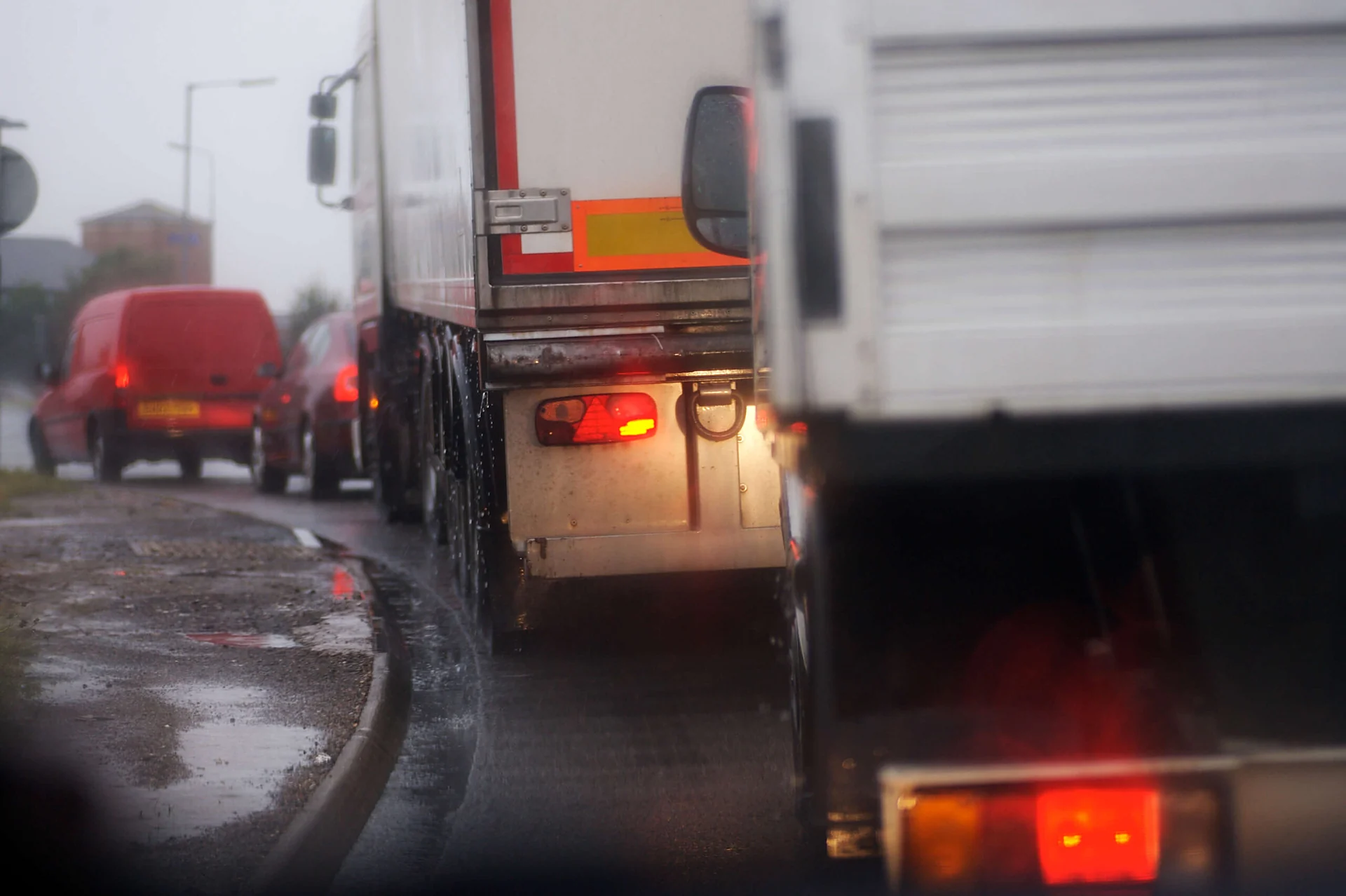
Jacksonville’s truck traffic is different from the interstate cities. There is no interstate here; freight moves on US-17 (Marine Boulevard) running north to New Bern and south to Wilmington, on NC-24 (Lejeune Boulevard) west toward I-40, and on NC-53, and much of it is base logistics: contractors, fuel and supply haulers, moving companies, and construction fleets serving Camp Lejeune and MCAS New River. Those are two-lane and four-lane highways with driveways, crossovers, and signalized intersections where a tractor-trailer’s stopping distance meets a passenger car turning across it.
When that collision happens, the injuries are severe and the defendant is a company with a plan. Joshua E. Palmer, Attorney at Law concentrates in truck and commercial-vehicle injury claims and represents crash victims across Jacksonville and Onslow County, including service members and their families. North Carolina Central University School of Law is where Attorney Palmer trained in North Carolina law. This page covers the Jacksonville specifics; the federal evidence and coverage rules are explained in depth on our North Carolina truck accident lawyer page.
| County | Onslow County |
|---|---|
| Where a lawsuit is filed | Onslow County Courthouse, 625 Court St, Jacksonville. Truck injury lawsuits over $25,000 are filed in Onslow County Superior Court; an out-of-state carrier may try to move the case to federal court. |
| Crash report (DMV-349) | Jacksonville Police Department for crashes inside the city; the NC State Highway Patrol for US-17, NC-24, NC-53, and roads outside city limits; military police for crashes aboard Camp Lejeune or MCAS New River. The DMV-349 for a commercial truck should list the carrier and its USDOT number; certified copies come from NCDMV. |
| Emergency and trauma care | Onslow Memorial Hospital’s emergency department; Naval Medical Center Camp Lejeune, a Level III trauma center, for eligible service members and families. Severe truck-crash injuries are often transferred to a Level I or II trauma center. |
| Roads where crashes concentrate | US-17 (Marine Boulevard), NC-24 (Lejeune Boulevard), NC-53, Western Boulevard, Gum Branch Road, Piney Green Road, and the base gate approaches. |
| Government and contractor trucks | A crash with a military or government vehicle, or a contractor working under a federal contract, runs on different claim rules and deadlines from an ordinary carrier case; have it reviewed immediately. |
Details current as of October 2026; confirm the courthouse and records office before you file or request anything in person.
Weight, insurance, and the opponent. A loaded tractor-trailer can weigh 80,000 pounds, so a US-17 collision that would be a fender-bender between two cars becomes a spinal injury, a brain injury, or a death. An interstate carrier hauling general freight must carry at least $750,000 in liability coverage under 49 C.F.R. § 387.9, compared with the $50,000 per person minimum a North Carolina driver carries under N.C. Gen. Stat. § 20-279.21, so the money to pay a serious claim usually exists. And the defendant is a company, often from another state, whose insurer dispatches investigators to a serious crash the same day.
The evidence that decides a truck case is created by the truck: electronic logging device records showing how long the driver had been on duty, the engine control module’s record of speed and braking before impact, dashcam video, dispatch and GPS data, the driver’s qualification file, inspection and maintenance records, and post-crash drug and alcohol test results. The carrier keeps all of it, and some of it may be lawfully discarded after a retention period unless a preservation demand is served. In Jacksonville, that letter is the first thing we send.
Get medical care the same day. For civilians that means the emergency department at Onslow Memorial Hospital; eligible service members and families may be treated at Naval Medical Center Camp Lejeune, and the most severe injuries are transferred to a larger trauma center. Truck crashes produce internal and spinal injuries that do not always show at the scene, and the carrier’s adjuster reads any gap in treatment as proof you were not badly hurt.
Make sure the DMV-349 is filed. Under N.C. Gen. Stat. § 20-166.1 the investigating officer reports any crash with injury, death, or $1,000 or more in damage, and for a commercial vehicle the report should identify the motor carrier and its USDOT number. Photograph the truck, trailer, placards, and plates, the debris field and skid marks, and your injuries. Collect witness names before they leave; in Jacksonville a witness may deploy before the case is ready. Then stop talking: no recorded statement to the carrier’s insurer or investigators, and nothing signed.
Because it is the carrier’s best defense. Pure contributory negligence is still the law in North Carolina, and it is all-or-nothing: any proven share of fault on your part, however small, means no recovery. The carrier must plead and prove it under N.C. Gen. Stat. § 1-139, and its investigators start building it at the scene, looking for a turn across US-17 that they can call too close, a phone record, a few miles over the limit on NC-24, or a merge from a gate approach.
The exceptions are where truck cases are often won. Under last clear chance you can still recover if the truck driver had the final chance to avoid the collision and failed to take it. Gross negligence or willful and wanton conduct, a driver far over his hours-of-service limits or a carrier that kept an unqualified driver on the road, defeats the defense entirely and opens the door to punitive damages, capped at the greater of three times compensatory damages or $250,000 under N.C. Gen. Stat. § 1D-25. Seat-belt non-use cannot be used against you under N.C. Gen. Stat. § 20-135.2A(d). Our contributory negligence guide covers every exception in depth.
Often several parties, each with its own policy. The driver is responsible for his own negligence; the motor carrier is responsible for its driver and for its own hiring, training, supervision, and hours-of-service failures; the owner of the tractor or trailer, the shipper that loaded the cargo, the broker that arranged the load, and a maintenance contractor can each carry liability. Identifying every one of them is what turns a claim against one driver’s policy into a claim against the coverage that can actually pay a catastrophic injury.
Jacksonville adds the government question. If the truck was a military vehicle, or the driver a federal employee or a contractor working under a federal contract, the claim may run through federal procedures with strict administrative notice deadlines rather than an ordinary lawsuit. That determination has to be made immediately, because those deadlines do not forgive delay.
| Rule | Law | What it means in Jacksonville |
|---|---|---|
| Carrier minimum liability | 49 C.F.R. § 387.9 | At least $750,000 for interstate general freight; more for hazardous materials |
| Passenger-car minimum liability | N.C. Gen. Stat. § 20-279.21 | $50,000 per person / $100,000 per accident for policies issued or renewed on or after July 1, 2025 |
| Fault rule | N.C. Gen. Stat. § 1-139 | Pure contributory negligence; the carrier must prove any fault it claims you share |
| Injury lawsuit deadline | N.C. Gen. Stat. § 1-52(16) | 3 years from the crash, filed in Onslow County Superior Court |
| Wrongful death deadline | N.C. Gen. Stat. § 1-53(4) | 2 years from the date of death |
Government and contractor vehicles run on separate federal claim procedures with shorter notice deadlines. Evidence retention periods are shorter still.
Three years from the crash for injury claims under N.C. Gen. Stat. § 1-52(16); for a wrongful death claim the window is two years from the date of death under N.C. Gen. Stat. § 1-53(4). Those are the legal deadlines. The practical ones are measured in days: dashcam loops overwrite, log records reach the end of their retention period, the tractor is repaired, and the witness who saw the truck run the light on Marine Boulevard ships out. A preservation demand to the carrier in the first week is what protects the claim.
Serious truck crashes on US-17 and NC-24 outside the city are usually investigated by the State Highway Patrol, and a Highway Patrol reconstruction can take weeks. We pull the DMV-349 and the reconstruction file as each is released and build our own timeline from the truck’s data alongside them.
Truck claims are valued like any North Carolina injury claim: medical expenses measured by what was paid or is owed, lost wages and earning capacity, future care, and non-economic damages for pain, suffering, and permanent impairment, with no cap on compensatory damages. The scale is what changes. Injuries from a tractor-trailer are more often surgical and permanent, and the carrier’s coverage is large enough to pay for them, so the fight is over liability and value rather than a thin policy.
For a service member or dependent, TRICARE or the government may assert a reimbursement claim against the recovery; we account for it from the start. Our settlement guide explains how North Carolina claims are valued, and the Jacksonville personal injury lawyer page covers the local court, report, and hospital details for every kind of Onslow County claim.
Because a truck case is decided in the first two weeks: the preservation demand, the report and reconstruction, the vehicle held for inspection, and every responsible company and policy identified before the first demand goes out. Attorney Palmer trained in North Carolina law and prepares every Jacksonville case as if it will be tried in Onslow County Superior Court, which is how the carrier’s insurer learns to price it.
We serve Jacksonville clients by phone, video, and in person by appointment, work around orders and deployments, and handle the TRICARE and medical liens as part of the case. Consultations are free, and a fee is owed only if we win. Earlier truck and injury cases are summarized on our case results page, with the usual caution that every case is different and prior results do not guarantee a similar outcome.

Joshua E. Palmer
Managing Partner · Joshua E. Palmer, Attorney at Law
Attorney Palmer concentrates in personal injury law — car, truck, and motorcycle crashes, wrongful death, workplace injuries, and premises injuries — and personally handles the insurance fight that decides a North Carolina claim. He trained in North Carolina law at North Carolina Central University School of Law in Durham and represents clients throughout Onslow County.
Hit by a truck in Jacksonville or anywhere in Onslow County? Call for a free case review. We will explain what evidence must be preserved this week, whether federal claim rules apply, and what your claim may be worth.
Responsible attorney: Joshua E. Palmer, Managing Partner · 106 Moran Dr #5106, Bonaire, GA 31005 · (478) 887-3734. Attorney advertising. This page is general legal information about North Carolina law, not legal advice for your situation; contacting the firm does not create an attorney-client relationship.
The carrier is already building its case. One free conversation puts someone on yours, preserves the evidence, and protects your claim from North Carolina’s contributory negligence rule. No fee unless we win.
Each case is different. Any results, settlement figures, or benefit amounts described on this page depend on the specific facts of that case and do not guarantee or predict a similar outcome in yours. Statutes and benefit rates cited are current as of October 2026; confirm current law with an attorney before relying on it.
📞 Get A Free Consultation · (478) 887-3734