
Almost every intersection crash in North Carolina comes down to one question: who had to yield? Here is what the statutes say for each situation, what a violation costs, and how the answer decides an injury claim.
Also called: failure to yield, § 20-155, rules of the road
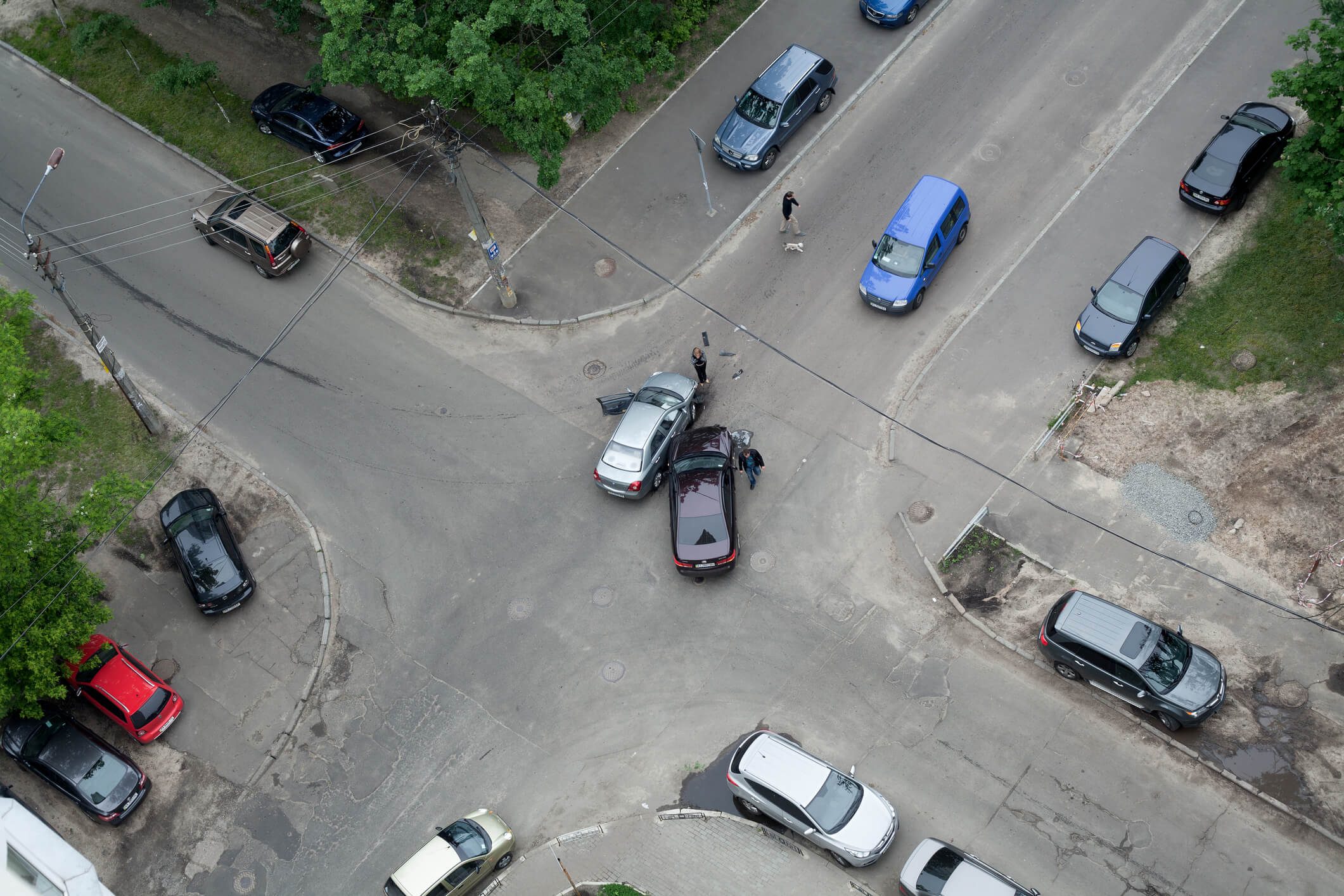
Right-of-way is not a courtesy in North Carolina; it is a set of statutory duties, and the driver who breaches one usually pays for the crash. Most drivers half-remember the rules, which is why intersection collisions produce so many disputed crash reports: both drivers believe the other had to yield, and the statute says only one of them is right.
This page sets out the right-of-way statutes situation by situation: uncontrolled intersections, left turns, driveways, stop signs and signals, dark signals, and emergency vehicles. It then explains the penalties and how a violation decides fault in an injury claim under North Carolina’s contributory negligence rule. Joshua E. Palmer, Attorney at Law handles intersection crashes across North Carolina, and this analysis is where every one of those cases begins.
At an intersection with no sign or signal, N.C. Gen. Stat. § 20-155(a) sets the rule: when two vehicles approach or enter the intersection from different highways at approximately the same time, the driver on the left yields to the vehicle on the right. At a traffic circle, § 20-155(d) requires a driver approaching but not yet inside the circle to yield to a vehicle already in it. The firm’s answer on right-of-way in a roundabout applies that rule to modern roundabouts.
Signs and signals change the rule. Under N.C. Gen. Stat. § 20-158(b)(1), a driver facing a stop sign stops and yields to vehicles on the through highway; at an all-way stop, each driver stops and then proceeds with caution. A steady red light under § 20-158(b)(2) means stop and do not enter, with a right turn allowed after a complete stop unless a sign prohibits it; a flashing red is a stop sign under § 20-158(b)(3), and a flashing yellow means proceed with caution while yielding under § 20-158(b)(4). A driver stops at the stop line, else before the crosswalk, else at the point with a view of cross traffic, under § 20-158(b)(5). When a signal is dark from a power outage or malfunction, § 20-158(b)(6) makes the intersection an all-way stop unless an officer or another device is directing traffic.
| Situation | Who yields | Statute |
|---|---|---|
| Uncontrolled intersection, vehicles arriving at about the same time | The driver on the left | § 20-155(a) |
| Left turn at an intersection or into a driveway | The turning driver, to oncoming traffic | § 20-155(b) |
| Traffic circle or roundabout | The entering driver, to vehicles already in it | § 20-155(d) |
| Entering a highway from a driveway, alley, or private road | The entering driver, to all traffic on the highway | § 20-156(a) |
| Stop sign or flashing red light | The driver facing it, to through traffic | § 20-158(b)(1), (b)(3) |
| Right turn on red | The turning driver, to other traffic and pedestrians | § 20-158(b)(2) |
| Dark or malfunctioning signal | Everyone: an all-way stop | § 20-158(b)(6) |
| Emergency vehicle with lights and siren | Every other driver: pull right and stop | § 20-156(b), § 20-157(a) |
The turning driver. N.C. Gen. Stat. § 20-155(b) requires a driver turning left within an intersection, or into an alley, private road, or driveway, to yield to any vehicle approaching from the opposite direction that is within the intersection or so close as to constitute an immediate hazard. A green light does not change that: under § 20-158(b)(2a), a steady green lets a driver proceed with due care subject to the rights of pedestrians and other vehicles, so an unprotected left on green still yields to oncoming traffic. A steady yellow warns that red is coming.
The left-turn rule is the most litigated in the set because the oncoming driver’s speed is almost always the defense: the turning driver says the other car was speeding or ran the light, the oncoming driver says the turn was made into an immediate hazard. The crash report’s diagram, the signal timing, the point of impact, and any camera footage usually answer it.
A driver about to enter or cross a highway from an alley, building entrance, private road, or driveway must yield to all vehicles approaching on that highway under N.C. Gen. Stat. § 20-156(a). There is no “approximately the same time” test here; the entering driver yields, period, which is why a driver pulling out of a parking lot is usually at fault for a collision with through traffic. A driver leaving a driveway also yields to a pedestrian or bicyclist on the sidewalk it crosses.
Emergency vehicles take priority from everyone. Under § 20-156(b), drivers yield to police, fire, ambulance, rescue squad, and the other listed emergency vehicles giving warning by light and by siren audible from at least 1,000 feet, and such a vehicle may proceed through a stop sign, yield sign, or red light, though its driver still owes due regard for safety. N.C. Gen. Stat. § 20-157(a) tells every other driver what to do: drive immediately to the right-hand edge or curb and stop until it has passed. A stopped emergency or public service vehicle triggers the separate duty covered in the firm’s answer on North Carolina’s Move Over law.
Most rules-of-the-road violations in Article 3 of Chapter 20 are infractions under N.C. Gen. Stat. § 20-176(a), with a penalty of not more than $100 under § 20-176(b) unless the statute sets a specific one; a right turn on red that fails to yield to a pedestrian carries $100 to $500 under § 20-158(b)(2)c. A conviction also adds license points and insurance points, and a crash that injures someone can bring charges that depend on the driver’s conduct. The North Carolina DMV points page carries the license-point schedule.
A driver who violates a right-of-way statute is negligent per se, because the statutes exist to protect other road users from exactly that collision, and § 20-176(d) treats infractions the same as crimes for that purpose. Proving the violation proves the breach of duty; the injured person still shows causation and damages. The firm’s negligence per se entry explains the doctrine.
The same statutes cut the other way. North Carolina’s contributory negligence rule bars recovery entirely when the injured person’s own negligence contributed to the crash, so an insurer defending a left-turn or stop-sign case will argue that the driver who had the right-of-way was speeding, distracted, or failed to keep a proper lookout. Having the right-of-way does not excuse a driver from due care, and the defense is raised in nearly every intersection claim, which is why the officer’s fault code is the start of the analysis rather than the end, and why the sudden emergency doctrine and last clear chance are examined in every disputed crash.

Joshua E. Palmer
Managing Partner · Joshua E. Palmer, Attorney at Law
Attorney Palmer concentrates in personal injury law and trained in North Carolina law at North Carolina Central University School of Law in Durham. These pages explain the North Carolina rules he applies in client cases every week, in plain English, with the statute that sets each one.
Hurt in a North Carolina intersection crash? Call for a free case review. We will pull the crash report and tell you who had to yield and where the claim stands.
Responsible attorney: Joshua E. Palmer, Managing Partner · 106 Moran Dr #5106, Bonaire, GA 31005 · (478) 887-3734. Attorney advertising. This page is general legal information about North Carolina law, not legal advice for your situation; contacting the firm does not create an attorney-client relationship.
Tell us where the crash happened and we will tell you, for free, who had the right-of-way under North Carolina law and what that means for your claim. No fee unless we win.
Each case is different. Any results, settlement figures, or benefit amounts described on this page depend on the specific facts of that case and do not guarantee or predict a similar outcome in yours. Statutes and benefit rates cited are current as of November 2026; confirm current law with an attorney before relying on it.
📞 Get A Free Consultation · (478) 887-3734